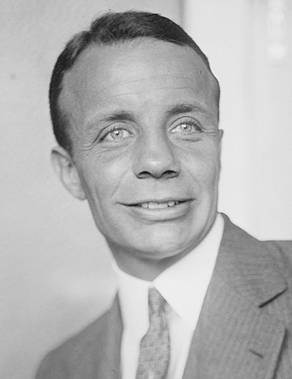
Theodore Roosevelt, Jr. Was fourteen when his father was elected the twenty-sixth president of the United States. Educated in public schools and at Groton and Harvard, he exhibited much of his father’s bounding energy and varied interests. But rather than politics, he choose business and periodic stints in the military.
His interest in military preparedness of the nation led him to help originate the Plattsburg Training Camp. He entered the service in April 1917 as a major, and was assigned duty as an instructor. In June he went to Europe with the 26th Infantry, 1st Division, as battalion commander; he later commanded the regiment. He was wounded and gassed at Cantigny and shot through the left knee at Soissons. On September 13, 1918 he was made lieutenant colonel.
While in France, he hosted a dinner on February 15th, in Paris composed of Officers in the A. E. F. Expeditionary Force. The main topic under discussion was the creation and the starting of some type of veterans organization. It was agreed, that the men would start the organization in France, and Roosevelt would promote the idea in the States upon his return. After being discharged in March 1919, he devoted much of his time for the next several months to publicizing and promoting the American Legion. Roosevelt was a member of the New York delegation to the St. Louis Caucus, May 8 - 10, 1919. He was elected as Temporary Chairman, he would refuse any other position in the future. Roosevelt is considered the founder of The American Legion.
When asked to describe the American Legion in one sentence, Roosevelt replied that it was “composed of men who intended to justify in time of peace the title of servicemen earned in the war,”
After the Minneapolis Convention, he was a member of the Committee on Civil Service Preference in 1921; of the Committee on Distinguished Guests during the Foch tour of 1921; and of the National Defense Committee.
Later, Roosevelt was assistant secretary of the Navy, 1921-23; led two expeditions into Asia for the Field Museum of Chicago in 1925 and in 1928-29. Later, he was governor of Puerto Rico (1929-33), where he organized village council meetings to promote democratic methods of dealing with problems. In later life, his civic work included stints as vice-president of the Boy Scouts of America and president of the National Health Council.
Roosevelt would maintain his Officers Reserve Corps commission and be ordered back to active service April 22, 1941, as a colonel with the 26th Infantry, 1st Division, the same as with his World War I service. As a brigadier general, Roosevelt would witness the military campaigns in Tunisia, Sicily, and Italy. At Normandy he was the first general officer to land on D-Day, at Cherbourg Peninsula. He died on July 12, 1944, of a heart attack while resting in the captured German truck that had been turned into a mobile office for his use. Theodore Roosevelt, Jr., would be elected and given the title of Past National Commander of The American Legion at the Legion Convention in Philadelphia, Pennsylvania, in 1949. (Dept. Photo).
